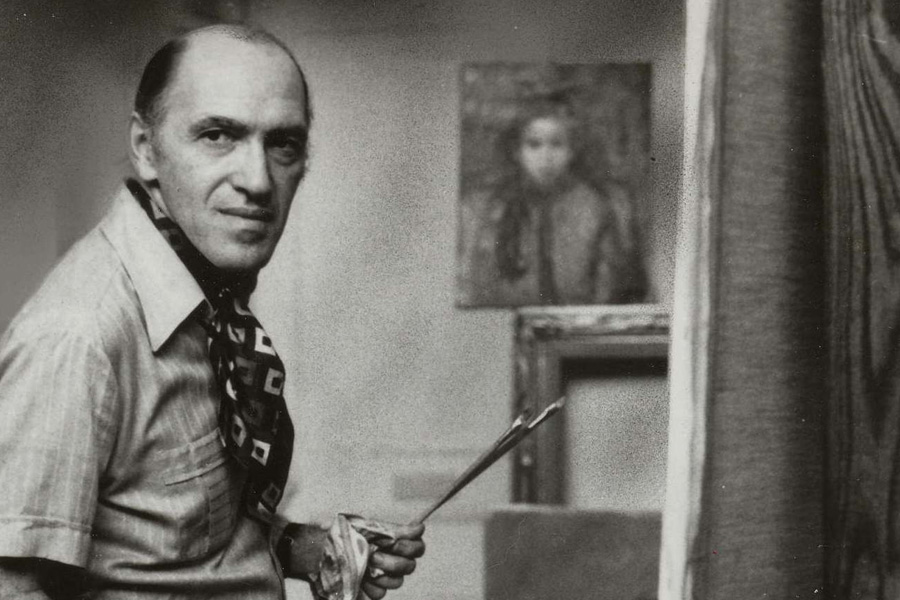
Basic Information
| Field | Detail |
|---|---|
| Full name | Irving Fierstein |
| Birth | circa 1913 (genealogical records often list Nov 11, 1913) |
| Death | circa February 1976 |
| Occupation | Handkerchief manufacturer — operated a small garment/textile factory |
| Spouse | Jacqueline Harriet (née Gilbert) |
| Children | Harvey Forbes Fierstein (b. June 6, 1952), Ronald Fierstein |
| Noted for | Father of actor/playwright Harvey Fierstein; his factory and trade introduced Harvey to sewing and industrial machinery |
Portrait in Facts and Trade
Irving Fierstein rarely appears as the star of headlines. His name sits instead in the margins of a larger life story: as a worker and owner in the textile trades, as a husband and father, and as the man behind the industrial sewing machines where a future playwright learned to thread a needle. Plain facts sketch him briefly — birth around 1913, a career tied to a handkerchief-manufacturing operation, and a death in the mid-1970s — but within those facts lie textures: the whir of machines, the clack of feeders, the scent of starch and cloth.
He belonged to a network of small manufacturers who kept specialized crafts alive in mid-20th-century urban America. Handkerchiefs, a modest product, required precision, steady labor, and a modest capital outlay: cutters, folders, and industrial machines that could stitch reliably through thin cotton, linen, or blends. Irving’s place in this trade tells us things about timing and class: small-scale manufacturing, immigrant or second-generation family businesses, neighborhood industry anchored in brownstone blocks and light-industrial corridors.
Family Table: People Closely Connected to Irving
| Relation | Name | Born / Died (where known) | Note |
|---|---|---|---|
| Wife | Jacqueline Harriet (Gilbert) | — | Reported as a school librarian; mother of Harvey and Ronald |
| Son | Harvey Forbes Fierstein | June 6, 1952 – present | Actor/playwright; early exposure to sewing in Irving’s factory |
| Son | Ronald (Ronald K.) Fierstein | — | Less publicly documented; identified as Harvey’s brother |
| Parents (reported) | Harry Fierstein & Rose (Magid) | — | Genealogical records vary; parentage appears in family trees |
The Factory as a Classroom
A machine can teach as strictly as a teacher. For Irving’s children, particularly Harvey, the factory was less a workplace and more a place of apprenticeship. Early memories — a child’s hands guided to sew, the geometry of cloth, the discipline of repetitive craft — became metaphors and motifs in later creative work. The industrial sewing machine is an emblem throughout stories of families who worked in garment trades: a rhythmic mentor, a hum that measures childhood.
Running a handkerchief factory offered Irving a hands-on management of small-scale production: buying cloth, overseeing cutters, ensuring quality control, and managing labor. In such environments, roles blur. Fathers fix machines at dusk. Mothers wrap finished goods for shipment. Kids learn to measure, to mend, to anticipate. That practical education — counting stitches, pacing one’s hands to the machine’s tempo — is a tactile legacy often overlooked in conventional biographies but crucial to the shaping of identity.
Dates, Numbers, and the Small Ledger of a Life
- 1913: Year commonly cited as Irving’s birth (some records point to November 11, 1913).
- 1952: Birth year of his son Harvey (June 6), anchoring family chronology in mid-century Brooklyn.
- Circa 1976: Genealogical entries list Irving’s death around February of 1976, placing his life span at roughly 62–63 years.
- 2 sons: The household included at least two male children — Harvey and Ronald — forming a compact family unit typical of the era.
Numbers reduce a life to coordinates, yet the ledger hints at rhythms: decades of work, the passing of knowledge from hand to hand, a single small factory that supported a family through postwar economic shifts.
A Quiet Influence on a Public Life
When a child leaves home to make a career in theater, journalism, or politics, people often search for the moment that lit the first spark. For Harvey Fierstein, that spark came in ordinary grease and cotton: learning to sew on his father’s industrial machine, watching bolts of fabric folded and hemmed, inhabiting the steady economy of a family craft. Those details anchor a public figure to a private origin — the domestic factory, the low hum of production — that later turns into narrative texture on stage and page.
Irving’s influence was not theatrical in the conventional sense. He did not direct plays or take the stage. Instead, he offered something less showy: a set of skills and a model of labor. The world that shaped his children was one of measured inputs and reliable outputs. For a playwright whose early life included literal stitching, the metaphor is almost literal: to build a story, stitch by stitch, seam by seam.
Timeline Snapshot
| Year | Event |
|---|---|
| c.1913 | Irving Fierstein is born. |
| 1940s–1960s | Operates in the garment/textile trade as handkerchief manufacturer; family life in Brooklyn. |
| 1952 | Son Harvey is born on June 6. |
| 1970s | Family transitions continue; Irving’s role as father and manufacturer remains a touchstone in family narratives. |
| c.1976 | Irving’s death is recorded around February 1976 in several family records. |
The Threads That Remain
Irving Fierstein’s public footprint is not large. He exists in collective memory primarily through familial ties and the industry in which he worked. Yet small biographies often contain the most human of textures: the domestic factory, the steadying presence of routine, lessons learned not through lectures but through labor. In that sense, Irving’s legacy is tactile, practical, and threaded through the life and words of his son — a reminder that the quiet workshop is sometimes the founding stage for louder art.