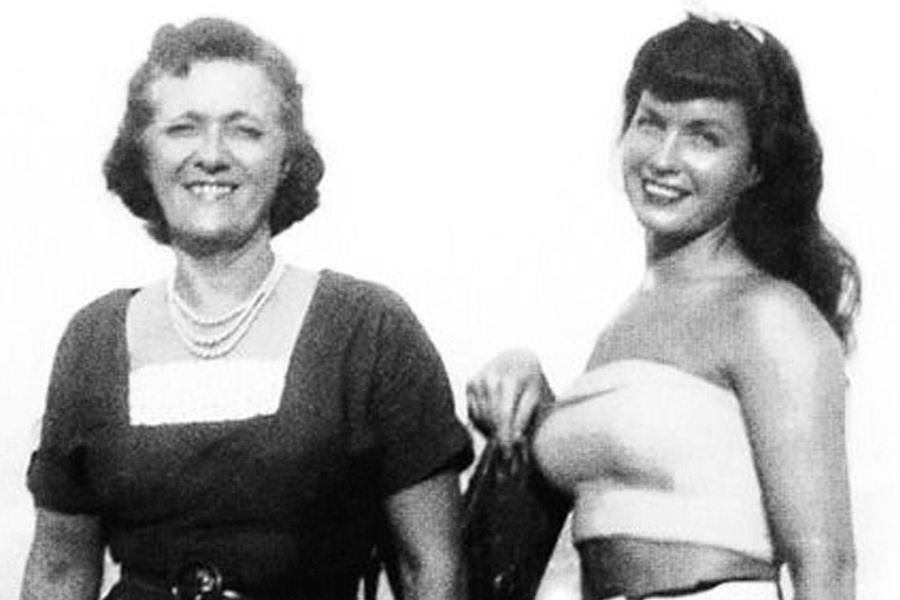
As I delve into the story of Edna Mae Pirtle, I find myself drawn to her like a forgotten chapter in a well-worn family album. Born on August 14, 1901, in the rural heart of Toone, Hardeman County, Tennessee, Edna embodied the unyielding spirit of Southern women navigating the turbulent waters of the early 20th century. Her life, though overshadowed by her famous daughter Bettie Page, stands as a testament to endurance amid poverty and personal trials. I picture her as a sturdy oak tree, roots deep in Tennessee soil, weathering storms that would fell lesser souls.
Early Years and Roots
Edna’s beginnings were humble, set against the backdrop of cotton fields and simple farm life. She entered the world as the daughter of Ewing Wesley Pirtle, born in 1858 and passing in 1919, a farmer who toiled under the relentless Southern sun, and Eliza Virginia Pugh, born in 1865 and living until 1944. Growing up in a large family, Edna learned early the rhythms of rural existence, where days stretched long and resources ran short. By 1910, census records paint a picture of her adolescence in Hardeman County, a place where economic hardships were as common as the summer heat.
In 1920, at just 19 years old, Edna married Walter Roy Page, born in 1896 and destined to die in 1964. He worked as an auto mechanic, a trade that promised stability but delivered frequent moves as the couple chased elusive opportunities. Their union, forged in the optimism of the Roaring Twenties, soon faced the harsh realities of life. I imagine their early days filled with hope, like a fresh dawn breaking over the Tennessee hills, only to cloud over with gathering storms.
Marriage and Family Challenges
Six children were born as a result of the marriage to Walter; each one brought happiness and hardship to their itinerant lifestyle. William Joseph “Billie” Page, their firstborn, was born in 1921 and lived until 2008. He later served in the military and relocated to California. Then, in 1923, came Bettie Mae Page, the second child who would go on to become a pin-up star and whose life was a roller coaster of tragedy and fame until her death in 2008. Following in 1924 was Jimmie M. Page, who died in 2008 after working in a variety of trades. Born in 1925 and lived until 2019, Gloria Jane “Goldie” Page became a homemaker in Georgia and preserved family memories through letters and pictures that provide insights into their common history.
Jack Page joined the family in 1928 and lived a more quiet life, with few records remaining over the years. Elizabeth “Betty” Page, the youngest, was born in 1932. Her story has faded into the past, making her even more mysterious. As a mother, Edna managed numerous births in the midst of frequent moves, her family traveling across unknown territory like a caravan. However, fissures started to show early. Walter’s untrustworthiness, together with claims of mistreatment and his incarceration for auto theft in the early 1930s, caused irreversible pressure on the relationship.
The marriage ended in divorce by about 1933, leaving Edna to bear the burden of the Great Depression by herself. When Bettie was just ten years old, she made the painful decision to send her and her two sisters in a Protestant orphanage for a year since she could not support all six of them with her low income. This difficult but sensible choice mirrored the struggles of the many single mothers of the time, whose lives were a patchwork of survival and sacrifice.
Life as a Single Mother
Edna rebuilt herself in Nashville after the divorce, working nonstop as a laundress by night and a hairdresser by day. In a time when women’s salary frequently fell between 50 and 60 percent of men’s, her days became a never-ending loop of earning salaries that hardly covered essentials. I visualize her, her resolve like forged steel, her hands rough from suds and scissors. Because of the patriarchal standards embedded in Southern culture, she gave priority to her sons, which occasionally caused her daughters to become resentful. Bettie subsequently talked about feeling unsupported in her goals, but Goldie’s stories show Edna as a devoted caregiver who gave her all under trying conditions.
Some of Edna’s anchoring came from her extended relatives. She was linked to Tennessee’s pioneer past through her Pirtle siblings and Pugh relatives, whose ancestors were 19th-century pioneers who forged forth on the frontier. Although there are few specifics, a brief remarriage to a man named Darby provided brief company. She carried on with her work throughout the 1940s and 1950s, even moving temporarily to Pennsylvania, where Bettie paid her a visit as her notoriety grew. Edna outlived Walter and remained close to her children, especially Goldie, living quietly in Nashville by the 1960s and beyond.
The Legacy Through Her Children
Edna’s influence rippled through her offspring, each carving paths shaped by her example of perseverance. Billie, the eldest, embodied duty with his military service, settling far from Tennessee’s embrace. Bettie, the most renowned, rose from humble origins to become a cultural icon, her pin-up poses challenging 1950s conventions, though her relationship with Edna bore scars of misunderstanding. Jimmie’s life in trades mirrored the practical skills Edna instilled, while Goldie’s role as family archivist kept their stories alive, contributing to narratives like books on Bettie’s lost years.
Jack and Elizabeth, though less documented, completed the family tapestry, their privacy a quiet counterpoint to Bettie’s public life. Together, Edna’s six children numbered a brood that spanned generations, their births from 1921 to 1932 marking a decade of growth amid adversity. In numbers: six children, two marriages, countless moves, and 84 years of life from 1901 to 1986. Her story, interwoven with theirs, reminds me of a river branching into streams, each carrying echoes of the source.
To illustrate the family structure, here’s a table summarizing her immediate kin:
| Relationship | Name | Birth-Death Years | Notable Details |
|---|---|---|---|
| Father | Ewing Wesley Pirtle | 1858-1919 | Farmer in Tennessee |
| Mother | Eliza Virginia Pugh | 1865-1944 | Rural homemaker |
| Husband | Walter Roy Page | 1896-1964 | Auto mechanic, imprisoned in 1930s |
| Son | William Joseph “Billie” Page | 1921-2008 | Military veteran, lived in California |
| Daughter | Bettie Mae Page | 1923-2008 | Famous pin-up model |
| Son | Jimmie M. Page | 1924-2008 | Worked in various trades |
| Daughter | Gloria Jane “Goldie” Page | 1925-2019 | Homemaker in Georgia, family archivist |
| Son | Jack Page | 1928-? | Private life |
| Daughter | Elizabeth “Betty” Page | 1932-? | Little known |
| Second Husband | Darby (last name unknown) | Unknown | Brief marriage post-divorce |
This table captures the essence of her connections, a network forged in hardship.
Key Moments in Her Timeline
Edna’s life unfolded across pivotal American eras, from rural beginnings to urban struggles. In 1901, her birth in Toone set the stage. The 1910s shaped her youth amid family farms. Marriage in 1920 launched her into adulthood, followed by children’s arrivals through the 1920s and early 1930s. The divorce around 1933 marked a turning point, thrusting her into single parenthood. The 1940s saw continued toil in Nashville, while the 1950s brought a Pennsylvania sojourn. From the 1960s to her death in July 1986, she embraced quieter days, buried in Pleasant Hill Baptist Church Cemetery in Jackson County, Tennessee.
Each decade layered complexity, her experiences a chronicle of quiet fortitude. Short bursts of change punctuated long stretches of routine, much like punctuation in a lengthy sentence.
FAQ
Who was Edna Mae Pirtle’s famous daughter?
Bettie Mae Page, born in 1923, became an iconic pin-up model whose image defined mid-20th-century allure, though her bond with Edna was complex, marked by perceived favoritism toward sons.
What challenges did Edna face after her divorce?
In 1933, post-divorce from Walter, Edna juggled dual jobs as a hairdresser and laundress, placing three daughters in an orphanage temporarily due to financial strain, a choice reflecting the era’s harsh realities for single mothers.
How many children did Edna have, and what were their names?
She had six: William Joseph “Billie” (1921), Bettie Mae (1923), Jimmie M. (1924), Gloria Jane “Goldie” (1925), Jack (1928), and Elizabeth “Betty” (1932), each navigating lives influenced by their mother’s resilience.
Where did Edna spend most of her life?
Primarily in Tennessee, from her birth in Toone to years in Nashville, with brief moves including to Pennsylvania in the 1950s, her roots always pulling her back to the South.
What was Edna’s occupation?
She worked as a hairdresser during the day and a laundress at night after her divorce, embodying the grit required to support a family alone during the Great Depression.
As I reflect on Edna’s journey, her story unfolds like threads in a quilt, pieced together from fragments of history and memory.