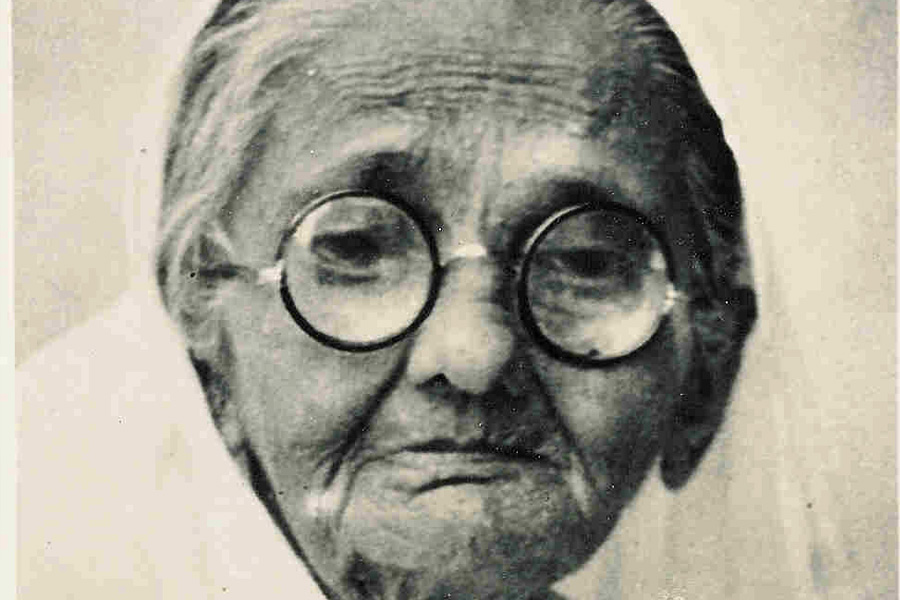
Biographical Overview
Raliatbehn Gandhi (commonly called Gokibehn or Raliat) was born around 1862 in Porbandar, British India, and died in 1960 at the reported age of 98. She occupied a private, steady place at the heart of a family whose public life would be thrown into the brightness of history through her youngest brother. Her life reads like a slow, steady current beneath the river of public events — steady, shaping, unseen.
Basic Information
| Field | Detail |
|---|---|
| Full name | Raliatbehn Gandhi (also Gokibehn / Raliat) |
| Approximate birth year | 1862 |
| Death year | 1960 (aged ~98) |
| Place of birth | Porbandar, Gujarat (then British India) |
| Parents | Karamchand Gandhi (father, 1822–1885) and Putlibai Gandhi (mother, 1844–1891) |
| Caste / community | Modh Bania (merchant/administrative community) |
| Spouse | Vrindavandas (married mid-1870s, traditional arranged marriage) |
| Children | Gokuldas (son), Phulkunwar (daughter) |
| Public role / occupation | Homemaker / family matron; no formal public career recorded |
| Notable appearances | Photographs from the 1930s (including care during a 1939 fast) |
Family and Personal Relationships
Raliatbehn was born into a household with administrative roots and devotional discipline. Her father, a career diwan and local administrator, anchored the family’s social standing; her mother instilled strict religious routines. The family network stretched across half-siblings and full siblings, several of whom remained in administrative or clerical roles, while one — Mohandas Karamchand Gandhi — rose to global prominence.
| Relationship | Name | Dates / Notes |
|---|---|---|
| Paternal grandfather | Uttamchand Gandhi | Born circa 1800; served as diwan of Porbandar; later exile and refuge in Junagadh |
| Paternal grandmother | Laxmiba Gandhi | Dates unknown; traditional household role |
| Father | Karamchand (Kaba) Gandhi | 1822–1885; diwan of Porbandar, Rajkot, Wankaner |
| Mother | Putlibai Gandhi | 1844–1891; devout, shaped domestic and spiritual life |
| Half-siblings | Muliben, Tulsidas, Pankunvarben | From father’s earlier marriages; limited public record |
| Full siblings | Laxmidas (1863–1914), Karsandas (c. 1866–1913), Mohandas (Mahatma) (1869–1948) | Laxmidas and Karsandas worked/served locally; Mohandas became national leader |
| Husband | Vrindavandas | Married c. mid-1870s; little public record |
| Son | Gokuldas Gandhi | Born late 1870s–1880s; private life |
| Daughter | Phulkunwar Gandhi | Born late 1870s–1880s; private life |
These names form a lattice of loyalties, obligations, and quiet labor. Women in the household — Putlibai, Laxmiba, Raliatbehn — acted as the repository of ritual, diet, and discipline; men administered civic duty and, in one case, history.
Life, Role, and Daily World
Raliatbehn’s life was shaped by dates, duties, and domestic rhythms rather than public appointments. Born into a middle-class administrative family, she entered an arranged marriage likely in her early teens — the social norm of the time — and raised two children. Her life was marked by care-giving tasks, ritual observance, and the management of a multi-generational household.
Her family followed Vaishnava and regional devotional practices with strong influence from Jain principles of non-violence and restraint. That household culture produced images later recalled by relatives: a devout mother; a father who kept civic rectitude; a sister who knitted the household together. Where history recorded loud footsteps elsewhere, Raliatbehn’s footsteps were the quiet ones that kept the house standing.
She is remembered in family recollections for her close relationship with her siblings. Anecdotal descriptions of the young Mohandas — “restless as mercury” — survive as family color, and Raliatbehn appears in photographs from the 1930s, including images showing her tending to her brother during a period of fast. Those photographs are rare but telling: they capture a sister performing the intimate, unrecorded labor that supports public lives.
Financially, the household was stable but not wealthy. Her father’s positions provided middle-class stability in colonial terms. There is no record of personal wealth, independent business ventures, or public office for Raliatbehn; her influence lay in the realm of family endurance and the transmission of values across generations.
Timeline of Key Dates and Events
| Year | Event |
|---|---|
| c. 1862 | Raliatbehn born in Porbandar. |
| Mid-1870s | Likely married to Vrindavandas (typical marriage age 13–16). |
| Late 1870s–1880s | Births of son Gokuldas and daughter Phulkunwar. |
| 1885 | Death of father, Karamchand Gandhi (1822–1885). |
| 1891 | Death of mother, Putlibai Gandhi (1844–1891). |
| 1913–1914 | Deaths of brothers Karsandas (c. 1913) and Laxmidas (1914). |
| 1930s | Photographs record Raliatbehn with her brother; care during fasts (including 1939). |
| 1948 | Assassination of Mahatma Gandhi; family generation profoundly affected. |
| 1950s | Lived quietly through the early years of independent India. |
| 1960 | Death of Raliatbehn at approximately 98 years old. |
Numbers anchor the rhythm of her life: dates of births and deaths, decades of quiet care, the slow march from colonial to independent India in which she witnessed seismic change from the eye of the domestic sphere.
Public Memory and Quiet Presence
Raliatbehn’s presence in public memory is intermittent and archival. She is not the subject of biographies or public offices; she is a figure in family trees, an occasional figure in photographs, a line in recollections that humanize a towering figure. Mentions in later decades have tended to be commemorative or illustrative — a sister’s care during a fast, a family snapshot, a voice that described childhood restlessness. Social memory treats her as a supporting chord rather than the melody; without that chord, the song would be thinner.
The story of Raliatbehn is, in a broader sense, the story of many women of her era: lives measured in household accounts, in the years that bind generations, and in the care that enables public action. Her longevity — nearly a century — made her a living bridge across eras: from mid-19th-century princely states through colonial upheaval into the first decades of an independent nation. She carried names, marriages, children, and rituals through those changes, and in doing so preserved a family’s continuity.
Family Portrait in Numbers
| Category | Count |
|---|---|
| Full siblings (including Raliat) | 4 |
| Half-siblings recorded | 3 |
| Children | 2 |
| Parents’ recorded life spans | Father: 63 years; Mother: 47 years |
| Raliatbehn’s approximate lifespan | ~98 years |
Raliatbehn Gandhi’s life resists headline capture. It resists the tidy tale of public achievement. Instead, it offers a different kind of legacy: the patient scaffolding without which public lives collapse. Like a seamstress whose stitches are invisible in finished cloth, she helped hold a family together while history pulled at its edges.